How to harvest from your balcony from spring to autumn, even if all you have is a few square meters and wind.
Because a balcony is not a small garden: it is a limited volume of soil, exposed, and it dries out fast. The right depths, the right varieties, the right amount of water.
The digital book "A Balcony That Feeds You", to read tonight and to use before your next trip to the garden center.
Keep reading if you finally want to know what works on YOUR balcony
Here is what you are going to understand on this page, and above all in the book that goes with it:
- How to measure the sunlight on your balcony in one day, and what each band of hours really allows you to grow.
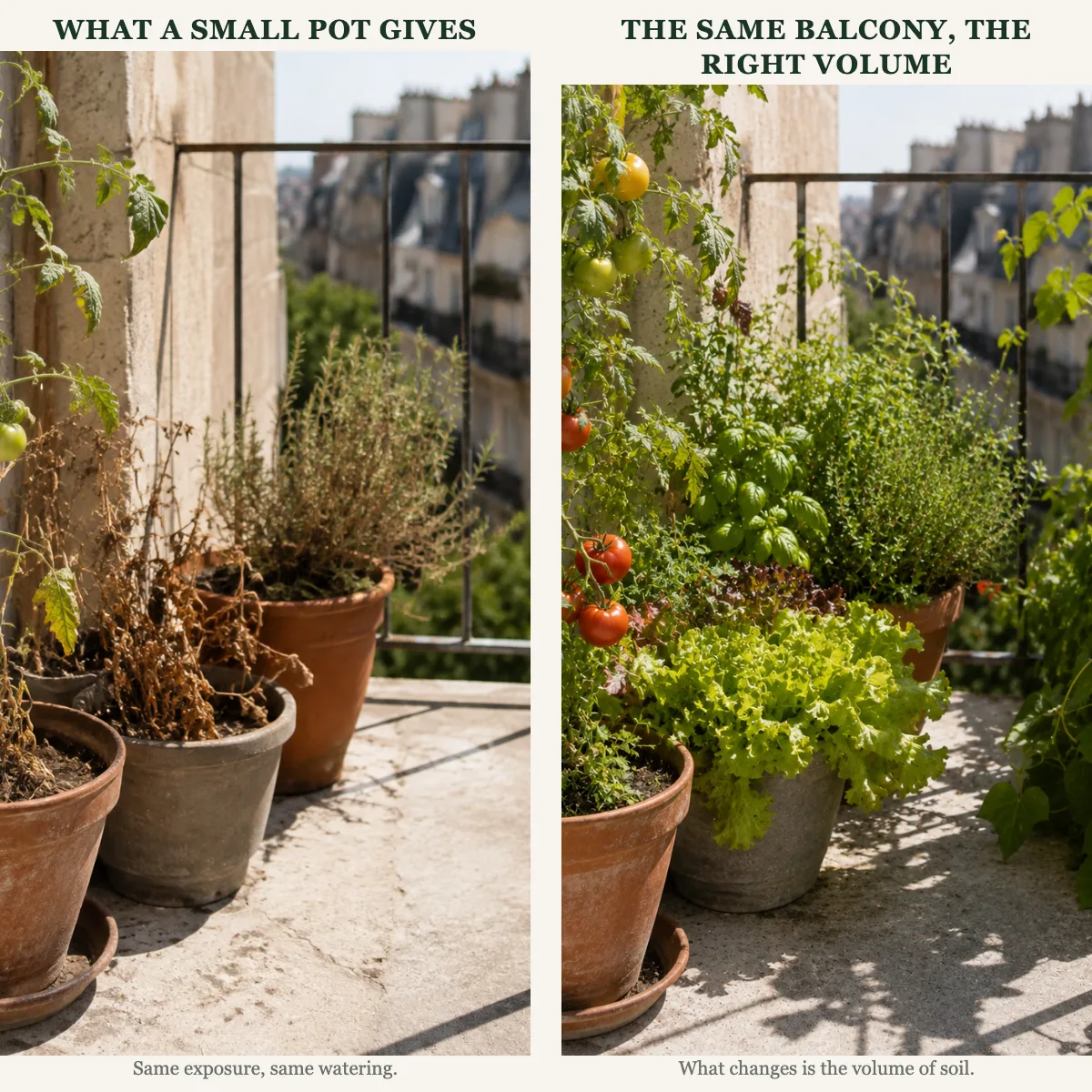
- The number of liters of soil each plant needs, and why a large-fruited tomato can NOT produce in a window box.
- Why your zucchini made flowers but not a single fruit, and the three-minute job that solves the most common case.
- The five seconds that replaces every watering schedule, and the two signals that lie to you.
From: Élise Marchand, for The Pot Method
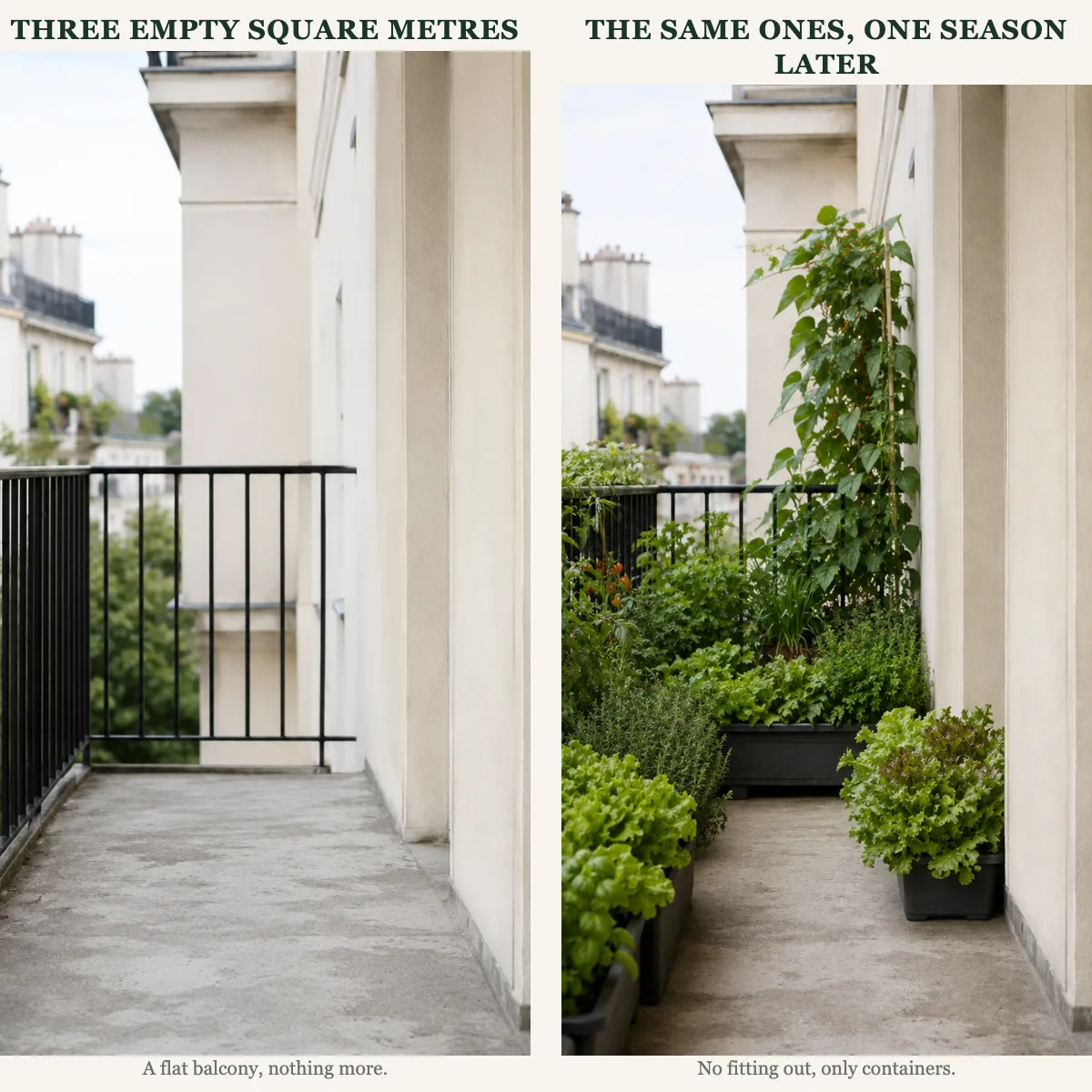
Place: on three square meters of concrete
Dear reader,
You simply want to harvest something at home, on that particular balcony, with the sun it gets and the space it has.
And you have probably already lost a season following advice written for a garden in open ground: varieties that grow too tall, containers that are too shallow, watering that does not last a windy day. That is not a lack of skill. It is that a balcony obeys other constraints, and nobody ever listed them for you.
Most vegetable gardening books give the balcony a chapter at the end, fifteen or so pages placed after three hundred pages about open ground. The same advice is repeated there, in a smaller version. "Choose dwarf varieties." "Remember to water more often." And you close the book with the feeling of having been handed a reduced version of something, rather than the right answer to your question.
A balcony is not a small garden. It is another craft.
A reader put it better than I could, in a review dated 13 August 2026: "This is a book that answers a real need, because it is very hard to find guides devoted solely to growing on a balcony."
This is that book.
Four differences, and they change everything
The wind. On a slab several floors up, the air never stops. It carries moisture away from the leaves continuously, and it is the first cause of drying out on a balcony, far ahead of the sun. Nobody thinks of it.
The concrete. Garden soil absorbs heat and gives it back slowly, at night. Concrete sends it straight back into the bottom of the pots. On a south-facing balcony in July, the soil in a window box standing directly on the ground rises several degrees above the surrounding air. The roots cook before the leaves wilt.
The volume. It is the most rigid constraint, and the easiest to measure. In a garden, a thirsty root goes down. In a pot, it reaches the bottom, then it circles. The volume of soil the plant has does not depend on any weather or any talent: it depends on you, and it is counted in liters.
The rain. It almost never falls on a covered balcony. You are the only source of water. A garden forgotten for two weeks in June survives. A balcony forgotten for four days in July does not.
The question nobody answers
Under gardening videos, one question comes back again and again, and it is usually left unanswered. It is always phrased the same way:
"On my balcony I planted zucchini and cucumbers, and I harvested nothing. Plenty of flowers but no fruit. What should I have done?"
There are four possible causes, they can be told apart by looking at the plant, and each one has a different answer. The first is the most common and comes down to a single figure: six hours of direct sun. Below that, the plant makes leaves and flowers, never enough energy to carry a fruit through to the end.
The second is unknown to most balcony gardeners, and it is settled in three minutes, one morning, with a flower in your hand. A whole part of the book deals with nothing but these four causes. There is no equipment to buy.
The reflex is to copy what gardens do, in a smaller version. That is how you lose a season: containers that are too shallow, varieties that grow too tall, watering that does not last the day as soon as there is wind.
What worked was to stop shrinking a vegetable garden and to treat the balcony for what it is: a limited volume of soil, exposed to the wind, that heats up and dries out fast. The whole book starts from that constraint, and gives, every time, the real depth, the real light and the real amount of water.
At this point, you have two options
A balcony is not a small garden: it is an exposed volume of soil.
The second option takes one reading and one job tonight. The first costs a whole season when you plant what will never survive in ten centimeters (about 4 in) of soil, and the most unfair part is that you do not even know you are getting it wrong.
Just imagine for a moment
- Imagine walking into the garden center already knowing, without hesitating, how many liters you need and what will do well at your place.
- Imagine a cherry tomato tied to your railing, giving one to two kilos, instead of three fruits on a plant that stalled all summer.
- Imagine knowing, in front of a wilting plant, whether it is thirsty or drowning, before you pick up the watering can.
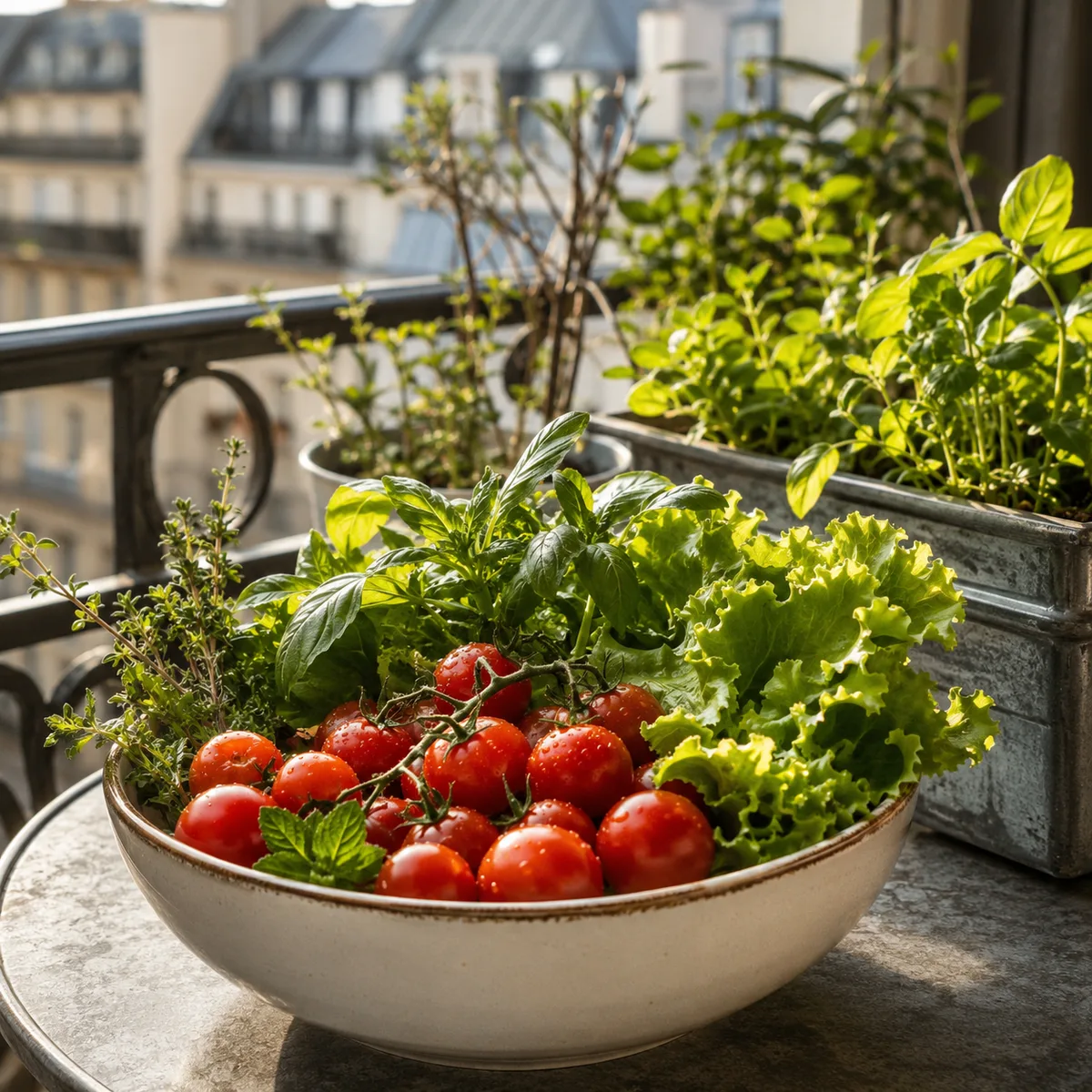
- Imagine harvesting lettuce through the cooler months, in two successive crops, in a single twenty-liter pot.
What you will be able to do when you close it
- Know your hours of direct sun, and choose your plants from that number instead of from a whim in the aisle.
- Buy the right pot first time, in liters and centimeters, never falling again for the "big pot" that is not one.
- Know, in front of a wilted plant, whether it is thirsty or drowning, before you pick up the watering can.
- Recognize the four causes of "flowers but no fruit" and know which one is yours in three looks.
- Pollinate a zucchini by hand in three minutes, one morning, and watch the fruit swell in the days that follow.
- Know what to do each month, including September, the most underused month on a balcony.
The appendices included in the book
Is this really for you?
And you?
You can close this page, and next year buy the same plants again in the same pots that are too small. Or you can, this weekend, step outside every two hours and note where the sun falls. The book is there for all the rest.
Measure the depth of your containers tonight, before you decide anything at all. If you find a container too shallow for what you put in it, you will know the problem was not your patience or your memory: it was that nobody had ever shown you where to look. The book is there for all the rest, in order, without you having to choose between two opposite opinions.
"A Balcony That Feeds You"
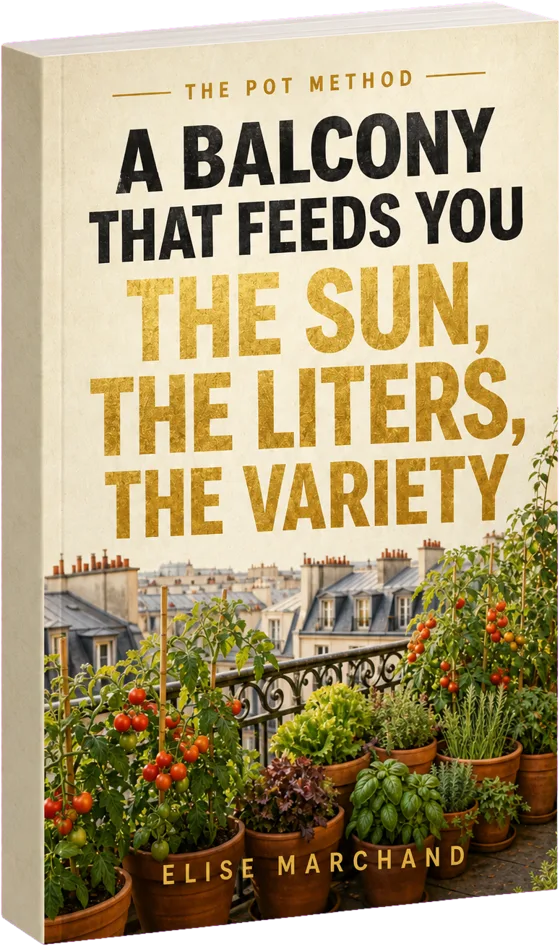
A digital book in PDF format, to read on your phone at the garden center, on your computer, or printed out if you prefer paper. It is built around one simple idea: on a balcony, it is the liters that decide, not good intentions. Every plant is given with its exact volume, in liters and in centimeters of depth, never as a "big pot" or a "medium pot".
It is written for someone who is starting out, in the words you use. You do not live in an "urban growing space": you have a balcony, and often a small one. And when a figure is given, you can check it in the shop: a round pot thirty centimeters (about 12 in) across and thirty deep holds nineteen liters (about 5.0 US gallons), not thirty as almost everyone believes.
What you will find inside, part by part
Start with parts 1 and 2, and measure two numbers: your hours of sun, and your liters. One morning, once and for all. Everything else hangs on them.
What your balcony can carry
You will know, with the figure in hand, how many hours of sun you really have, and therefore what it is realistic to grow there.
- The sunlight survey in one day, every two hours, and the four real cases: less than two hours, two to four, four to six, more than six.
- Why you have to do the survey again at the end of June, and which of the two figures is the one you use to choose your plants.
- The weight of a full, watered window box, where to put the heavy containers, and the three precautions to take when you do not know your balcony's load limit.
- The three ways wind behaves several floors up, and how to spot the corner eddy with three ribbons and three days of observation.
- Why an openwork windbreak protects and a solid panel makes worse the very problem it claims to solve.
Volume, the real limit
You will know which container each plant needs before you buy it, and you will stop losing a season in a pot that is too small.
- The volume table, sixteen plants, three columns: the minimum below which nothing works, the comfortable volume, and the depth.
- Why a large-fruited tomato can NOT produce in a standard balcony window box, and what to choose instead.
- The two formulas that give you the liters of a round pot and of a window box, in centimeters, so you stop buying by eye.
- The layer of clay pebbles at the bottom of the pot: why it does not drain, what it really does, and where it is genuinely useful.
- Why garden soil turns into a hard block in a pot, and the mix that lasts two seasons.
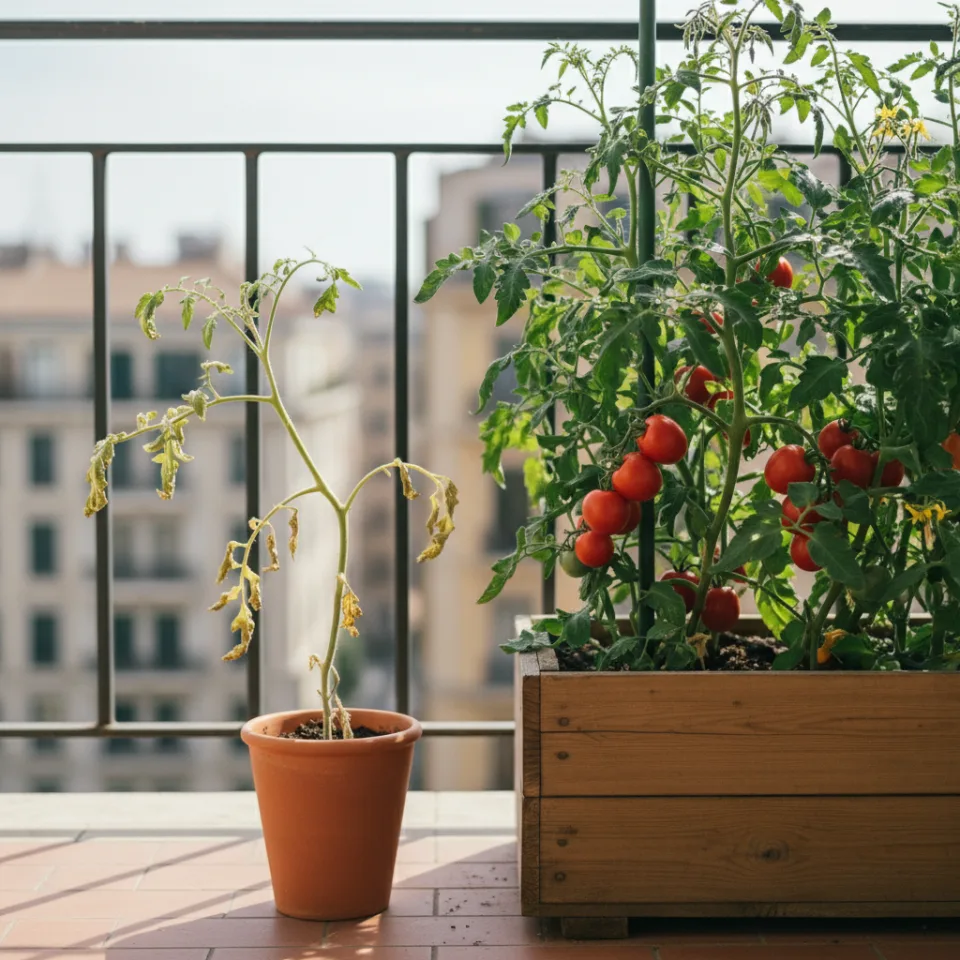
Watering when you are the only rain
You will know, in five seconds and without a schedule, whether that pot needs water today, and you will no longer mistake thirst for drowning.
- The five-second test that replaces every watering frequency, and why no schedule can take six variables into account.
- The two signals that lie: the dry surface, and the wilted plant. Damp soil and a wilted plant, and the problem is the opposite of what you think.
- Why a small daily watering builds a fragile plant, and what to do instead.
- The three heatwave measures, in order of how well they really work, and the most effective of them costs almost nothing.
- What really works for an absence of four to seven days, and what does not work beyond that.
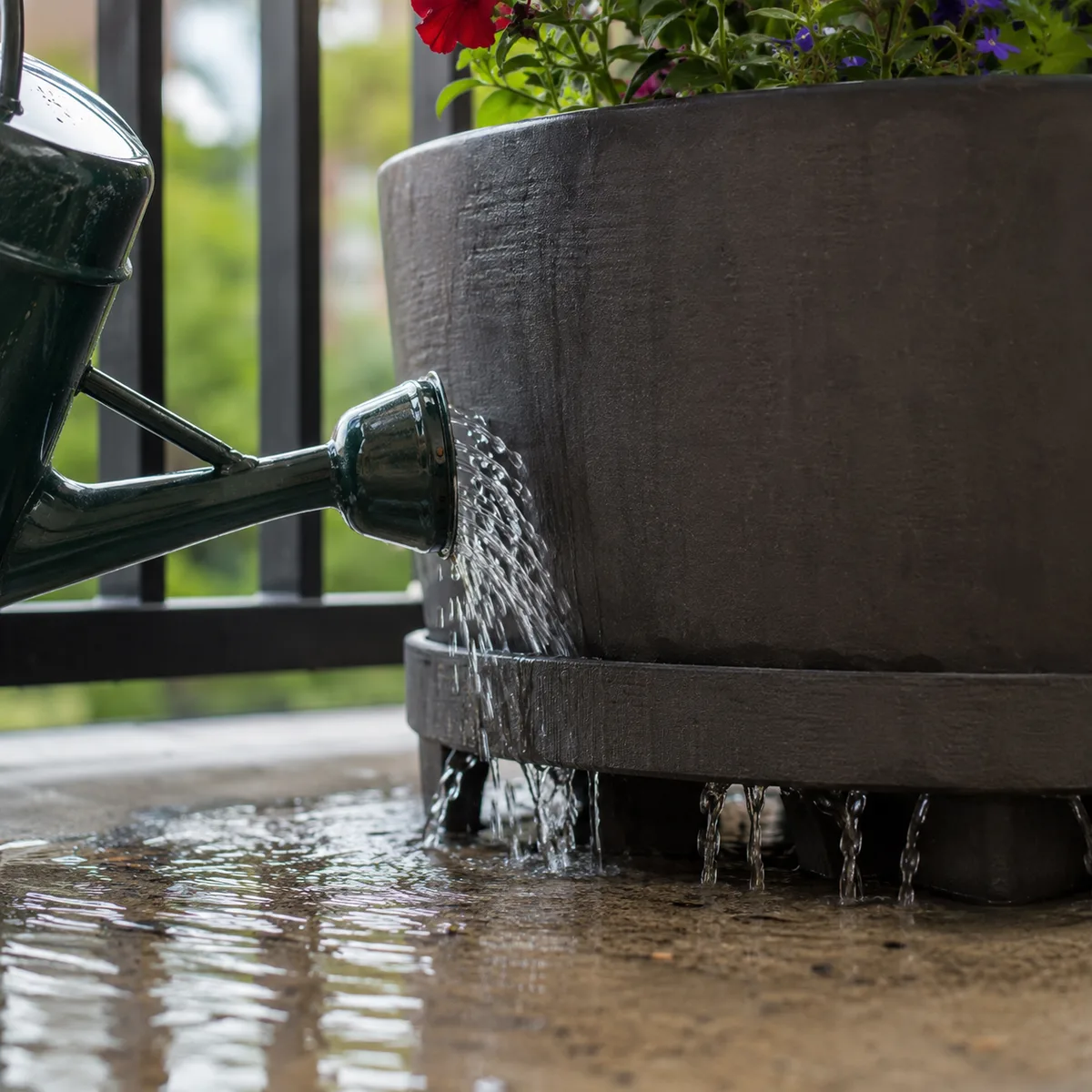
The twelve that really work
You will know what to start with for a first season that really gives you something to harvest.
- Twelve plants proven on a balcony, with their light, their liters, their depth and the harvest you can honestly expect.
- The absolute rule about mint, the one that explains why ready-made herb window boxes end up as mint alone.
- The most underrated plant on a balcony: six months of harvest, four hours of sun is enough, and nobody talks about it.
- Pinching basil: without it, it turns bitter and is finished in a month.
- And what does not work, said plainly: melon, watermelon, potatoes in a bag, corn, cauliflower, with the exact reason for each one.
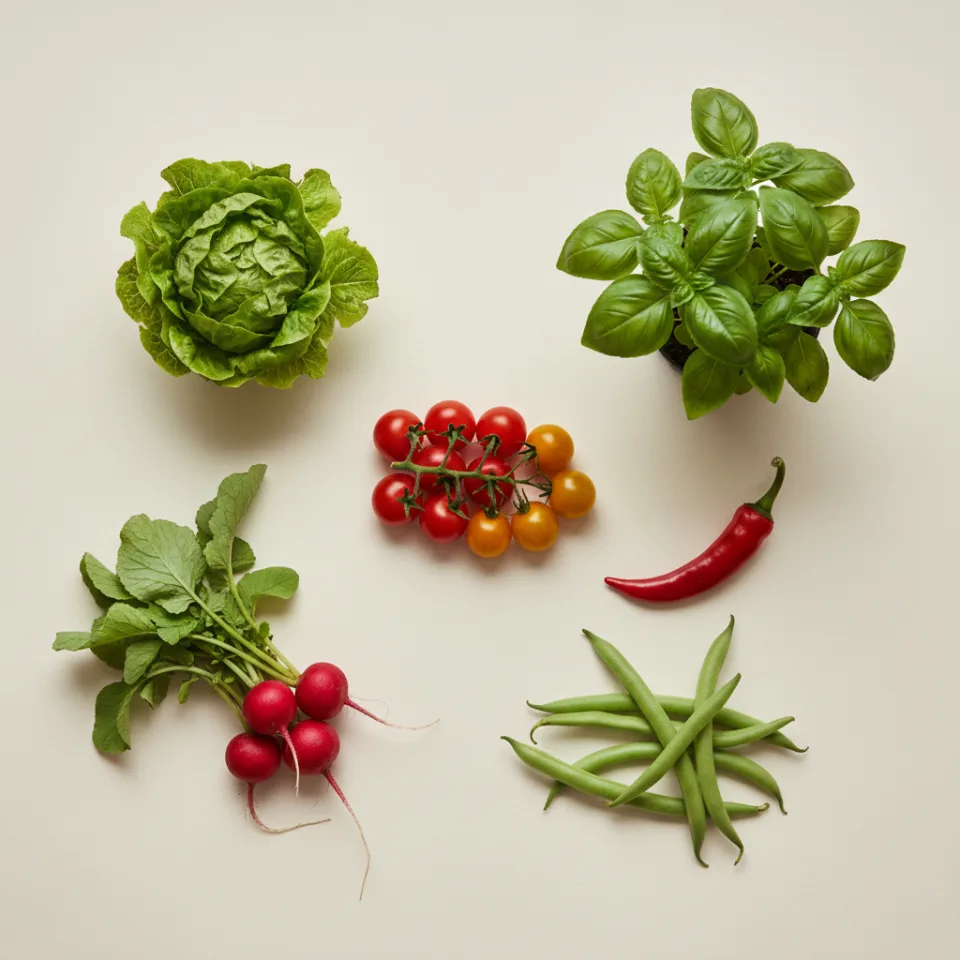
Flowers but no fruit
You will know which of the four causes applies to you, just by looking at the plant, and what to do that same day.
- The four causes, in the order in which to check them, and how to tell them apart by looking at the plant.
- The two kinds of flower on the same plant, in photos: how to tell the male from the female in one second.
- Hand pollination, between eight and eleven in the morning, in three steps. It works every time.
- Why beautiful foliage can be a bad sign, and the three weeks that get the plant going again.
- What happens above 35 °C (95 °F), and why a tomato watered irregularly drops its flowers then splits its fruit.
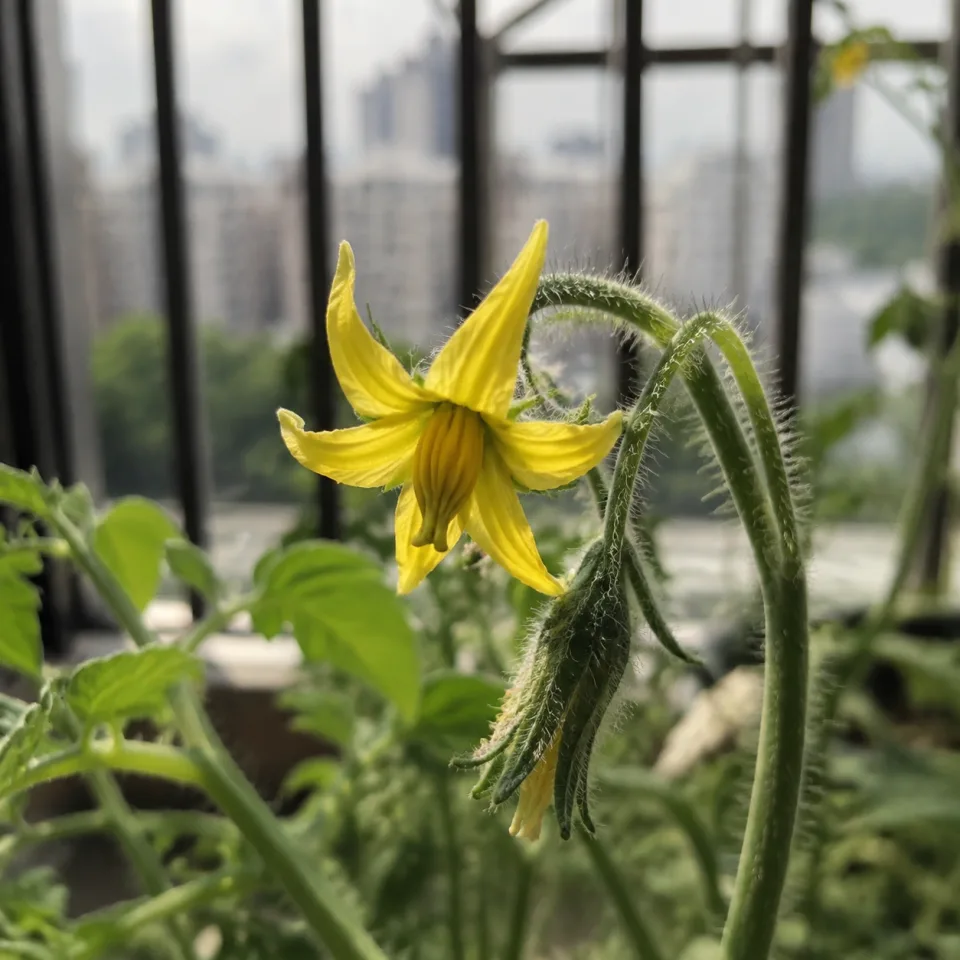
What you actually have in your hands
26 pages
"A Balcony That Feeds You" runs to 26 pages, with its photos and diagrams, plus the 15-page workbook if you add it. This is not a blog post stretched out: it is the whole book, as a PDF, yours to keep for life.
Everything can be checked before you even pay: you can see the full contents above, part by part, and each part matches a real chapter of the book.
What you receive today
This is everything in "A Balcony That Feeds You", gathered into a single file, to keep open beside your balcony while you work. Here is exactly what you receive:
- The book "A Balcony That Feeds You", fifteen figures and photosvalue $47
- The volume table: sixteen plants, in liters and in centimetersincluded
- The part "Flowers but no fruit": the four causes, in orderincluded
- The balcony calendar, month by month, on one page to pin upincluded
- The index by problem, written in your own wordsincluded
- Price$47
This is the price of the book, with no countdown and no timer. You keep it, with the updates.
Digital book in PDF, sent by email: nothing is posted, nothing arrives at your door.
30-day guarantee, no conditions
Read the book. Do the sunlight survey. Measure your pots. If within 30 days you feel it brings you nothing, write to us at contact@thepotmethod.com and you are refunded in full.
No form, no explanation to give, no questions. And you keep the book: I would not know how to take it back from you anyway.
In other words: either this book changes something for you, or it costs you nothing. I prefer that simple rule to a long list of conditions in small print. The only risk left is closing this page and starting again tomorrow, looking for an answer in two articles that contradict each other.
P.S. If you are skimming this page, here is the summary. For $47, you receive "A Balcony That Feeds You": the sunlight survey in one day, the volume table in liters, watering when you are the only rain, the twelve plants that really last along with the ones that do not, and the four causes of "flowers but no fruit". If it is of no use to you, you are refunded within 30 days and you keep the book.
P.P.S. Do one thing this weekend, even if you do not order. Step out onto your balcony every two hours, from eight in the morning to eight in the evening, and note each time whether the ground is in direct sun. Add it up. It is the most useful piece of information in this whole book, and you will have got it without paying anything.
The Pot Method publishes practical gardening guides. This book is about growing in containers and nothing in it is medical or nutritional advice.