How to keep your orchid alive and see it bloom again, even if it has not a single flower left today.
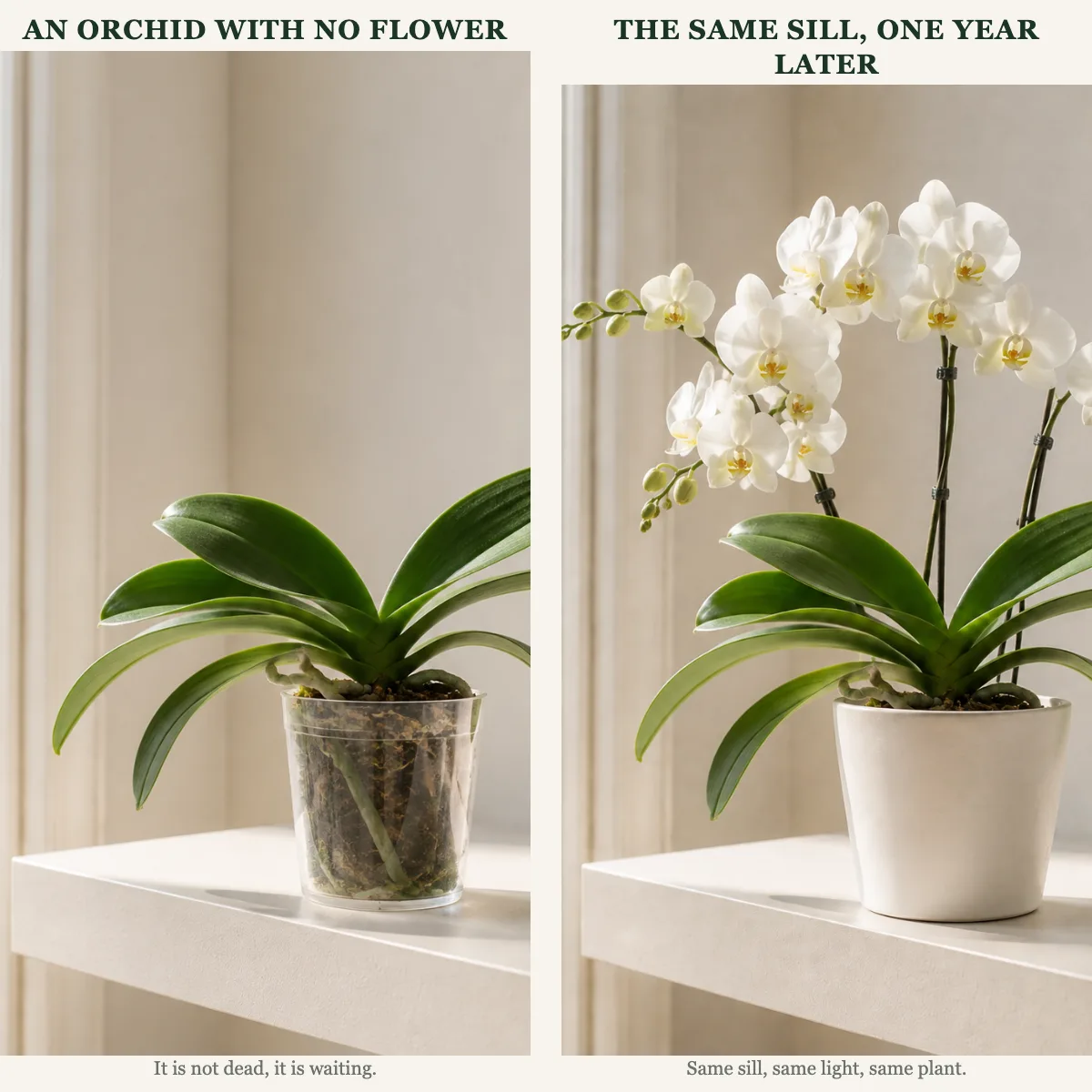
Because an orchid without flowers is not an orchid that is dying: it is an orchid that is resting. You still have to know how to read its roots and respect its season.
Nothing to install, no equipment to buy: a PDF book, to read next to your orchid, and the right watering move and your orchid's resting period from tonight.
The digital book "It Will Bloom Again", to read tonight and to apply from tonight.
Keep reading if you finally want to know when to water, and why it no longer blooms
Here is what you are going to understand on this page, and above all in the book that goes with it:
- Why an orchid without flowers is not ill, and what that state really means.
- The only watering indicator there is: the color of the roots, read through the clear pot, in five seconds.
- Why a limp leaf is a sign of thirst, and why that thirst almost always comes from too much water.
- What actually triggers a new bloom, and what almost nobody does.
From: Élise Marchand, for The Pot Method
Place: in front of an orchid received as a gift that had not flowered for two years
Dear reader,
There is one sentence I hear more often than any other, and it never says "my orchid is dead".
It says: "it does not bloom any more".
That is a sentence of disappointment, not of mourning. And that is already good news, because a plant you still expect something from is a plant that is still there.
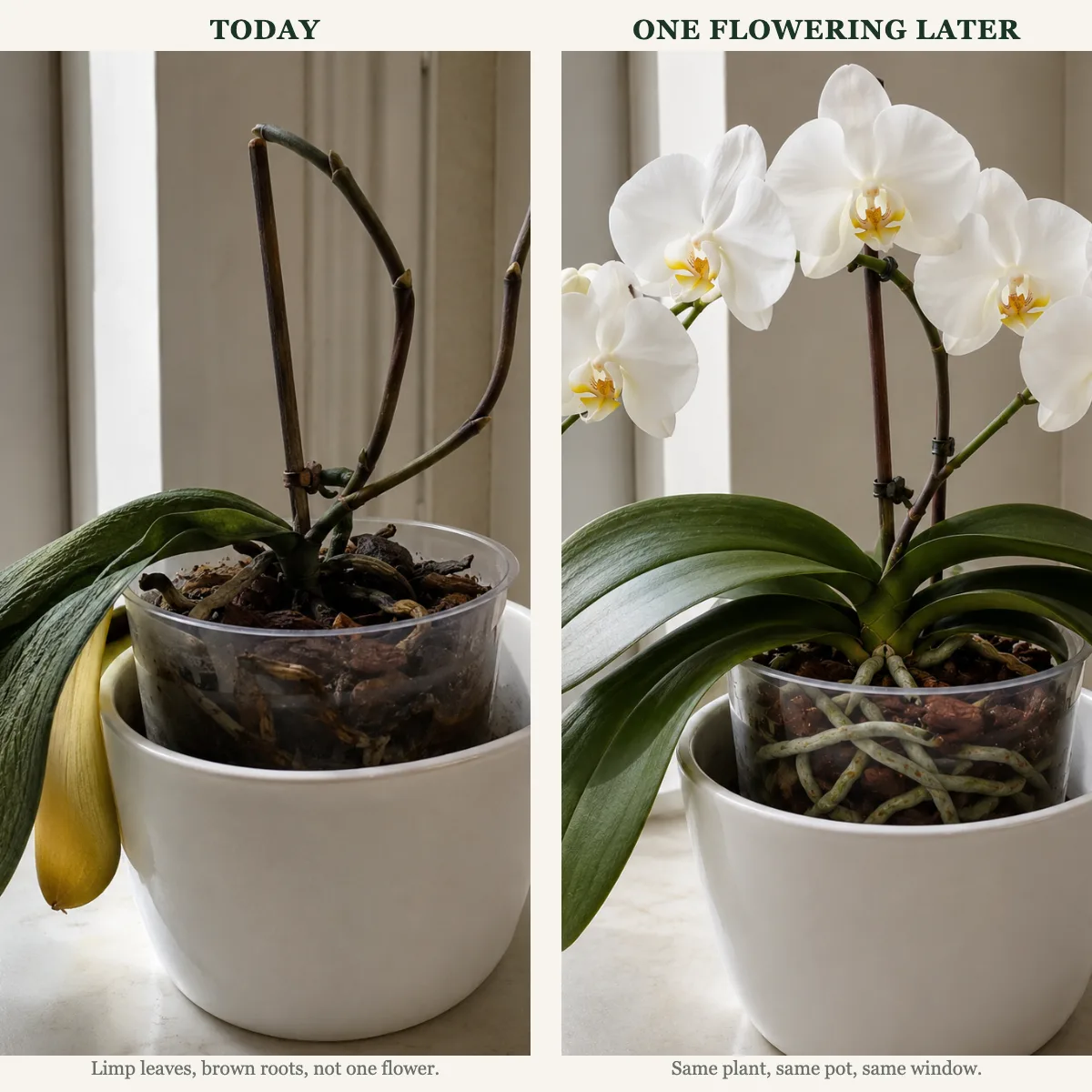
You were probably given it as a gift. Almost nobody buys their first orchid for themselves. It was beautiful, with an arching stem and a row of flowers that lasted two months. Then the flowers fell, one by one. What was left was a green stem, then a brown one, and four or five thick leaves.
You went on watering it. Perhaps with an ice cube, because somebody told you to. Perhaps a little water in the outer pot, because it seemed logical. And nothing happened.
So you looked it up. And you ran straight into the real problem with this subject.
The misunderstanding that costs the most orchids
I am going to ask you to accept one idea before anything else, because everything else follows from it. An orchid without flowers is not an orchid that is dying. It is an orchid that is resting.
In the country it comes from, it does not flower all year round. It flowers once, when something in its surroundings has told it the moment had come. The rest of the time it quietly builds the reserves for the next flowering. That flowerless period is not a breakdown: it is a normal phase of its life.
The trouble is that we bought it IN FLOWER. The orchids sold in garden centres arrive at the peak of their flowering, forced by greenhouses that know exactly how to do it. So we believe that the normal state of an orchid is "covered in flowers". And when it returns to its genuinely normal state, green and without flowers, we believe it has fallen ill.
So we step in. We water more, because it must be thirst. We add feed, because it must be hunger. We repot it, we move it, we cut the stem or we do not cut it depending on the last video we watched.
And that is where we lose it.
Almost every orchid that dies indoors dies of too much care, not of neglect. You have not been careless. You have been attentive in the wrong place, at the wrong moment, and nobody told you that "doing nothing" was an action.
The usual story
An orchid often arrives as a gift, for a house move or a birthday. It flowered for ten weeks. The day the last flower drops, you start looking after it seriously, with the best will in the world, and that is often when it dies. You pour water into the outer pot every week, the way you fill a bowl. When you finally lift out the clear pot to look, the roots are no longer roots: they are brown threads that come apart between your fingers.
I had not forgotten it. I had drowned it, diligently.
With the next orchid, you do the opposite. I was so afraid of starting again that I hardly watered it at all. It survived, shrivelled, and never bloomed again. I had replaced one mistake with its mirror image.
It was the third one that taught me something, and it fits into one sentence: stop looking at the plant, look at the roots. An orchid tells you everything, all the time, through its roots. They are visible through the clear pot, they change color within minutes, and they never lie.
At this point, you have two options
An orchid is read through its roots, not its leaves.
The second option asks for one reading and one action tonight. The first costs you a plant every time you mistake a rest for a death throe, and the cruellest part is that you never even know you are getting it wrong.
Just imagine for a moment
- Imagine knowing in five seconds, by looking at the pot, whether you water today or not. No calendar, no app, no hesitating.
- Imagine seeing a leaf turn yellow and knowing straight away whether it is normal renewal or the start of a problem.
- Imagine spotting, one November morning, a shoot with a flattened tip in the crook of a leaf, and knowing it is a flower spike.
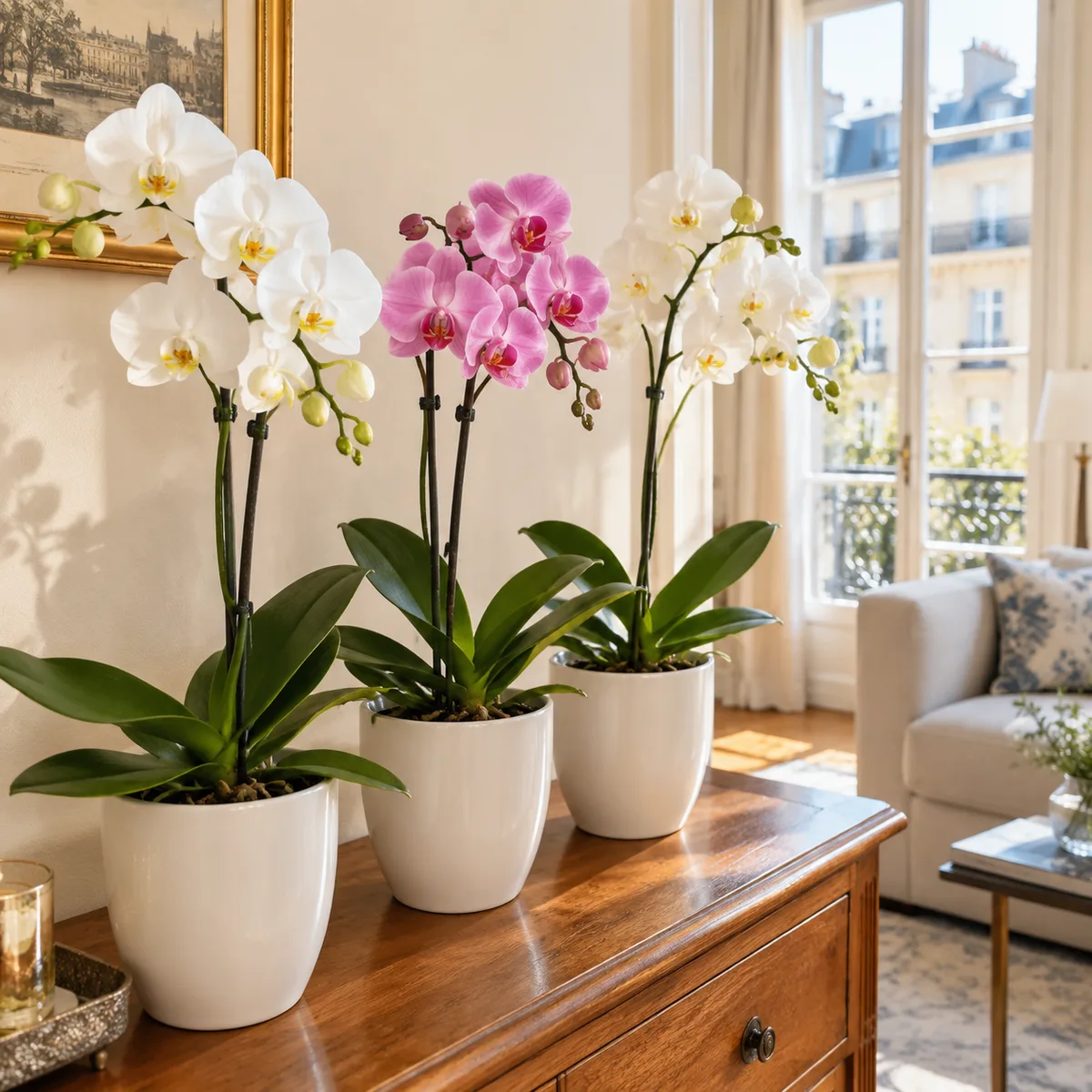
- Imagine seeing it bloom again. That one, the one you were given and thought was finished.
What you will be able to do when you close it
- Decide in five seconds, without hesitating, whether you water today or not.
- Identify your orchid among the eleven sold in garden centres, and know what its name changes.
- Look at a yellow leaf and know whether it is normal or a watering problem.
- Save a plant whose roots are damaged, as long as one firm root is left.
- Tell a flower spike from a root, from the very first centimeters.
- Give it the autumn signal that triggers a new bloom, at home, with no equipment.
- Choose an orchid in the shop already knowing whether it will last.
The appendices included in the book
Is this really for you?
And you?
You can close this page, and find the same green, silent plant a year from now. Or you can, tonight, lift out the clear pot and look at the color of the roots. The book is there for everything else.
Check your orchid's roots tonight, before deciding anything at all. If you find a spike you cut off just as it was about to start again, you will know the problem was never your patience or your memory: it was that nobody had ever shown you where to look. The book is there for everything else, in order, without leaving you to choose between two opposing opinions.
"It Will Bloom Again"
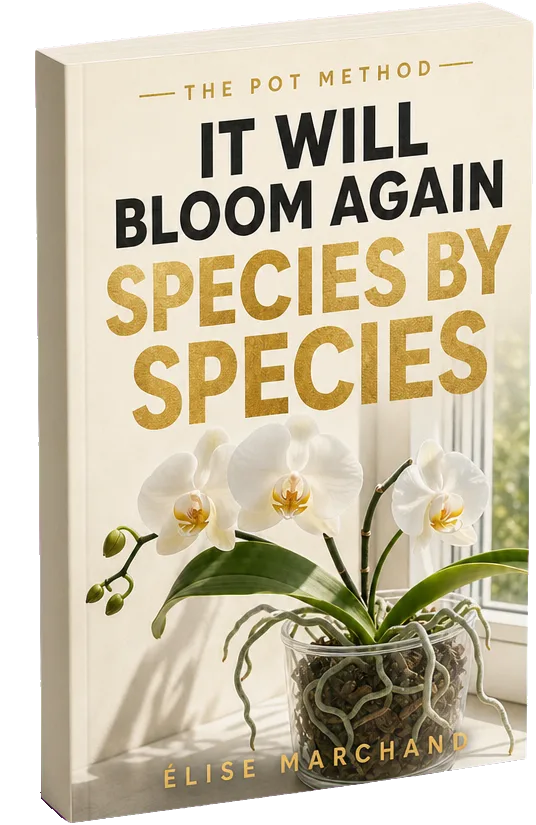
A digital book in PDF format, to read on your phone next to the pot, on your computer, or printed if you prefer paper. It holds to one rule I set myself: one photo per species. It is the first thing readers hold against orchid books, and they say so in their reviews.
It is written for someone starting out, in plain language with no expert's jargon. You will not read "velamen": you will read "the white spongy layer around the roots". You need nothing more than a clear pot and a window.
What you will find inside, part by part
You can read it in order, or go straight to the index by symptom at the back.
Identify yours
You will know which of the eleven orchids sold in garden centres you have, and whether it stores water, which decides your whole approach to watering.
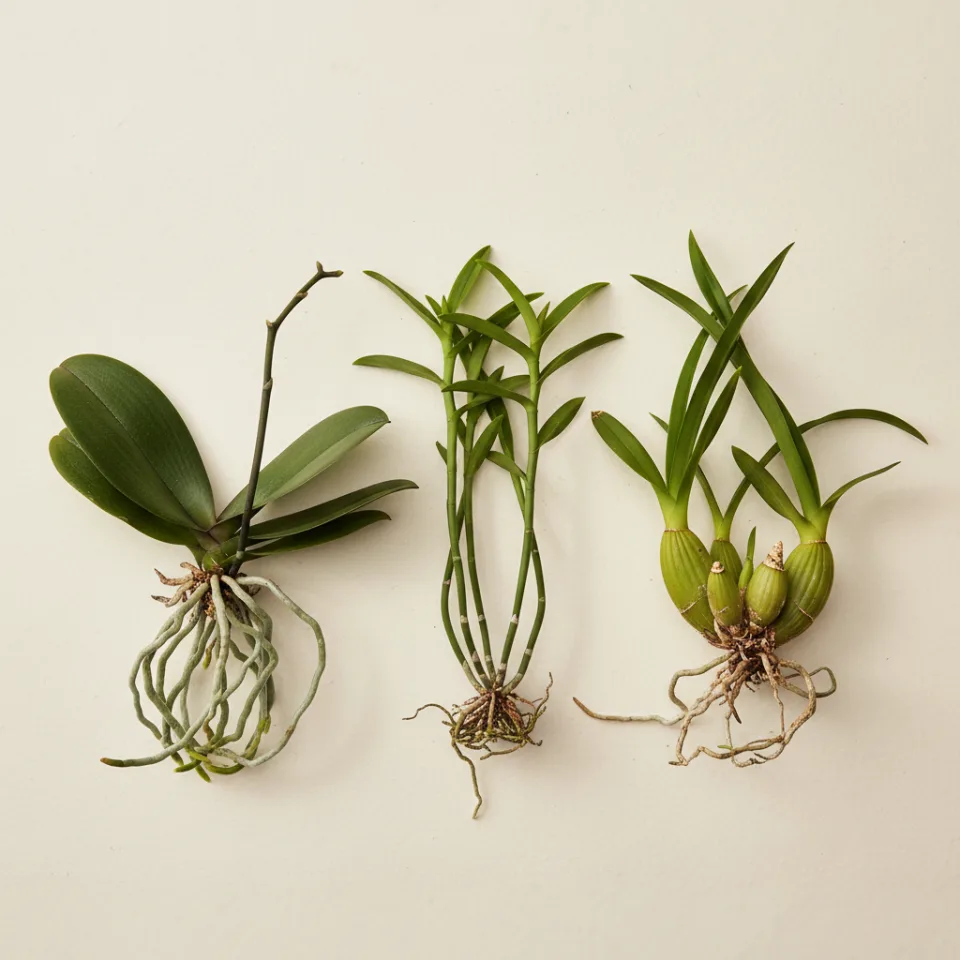
- The eleven orchids sold in garden centres, each with its photo: Phalaenopsis, Cymbidium, cane Dendrobium, Dendrobium nobile, Cattleya, Oncidium, Vanda, Miltonia, Paphiopedilum, Zygopetalum, Ludisia. Plus a twelfth sheet, "I do not know which one I have", to identify yours without a label.
- The swelling at the base: the ones that store water and the ones that do not. That is what decides your watering, and nobody told you.
- Why the clear pot is not an oversight by the seller, but your only measuring instrument.
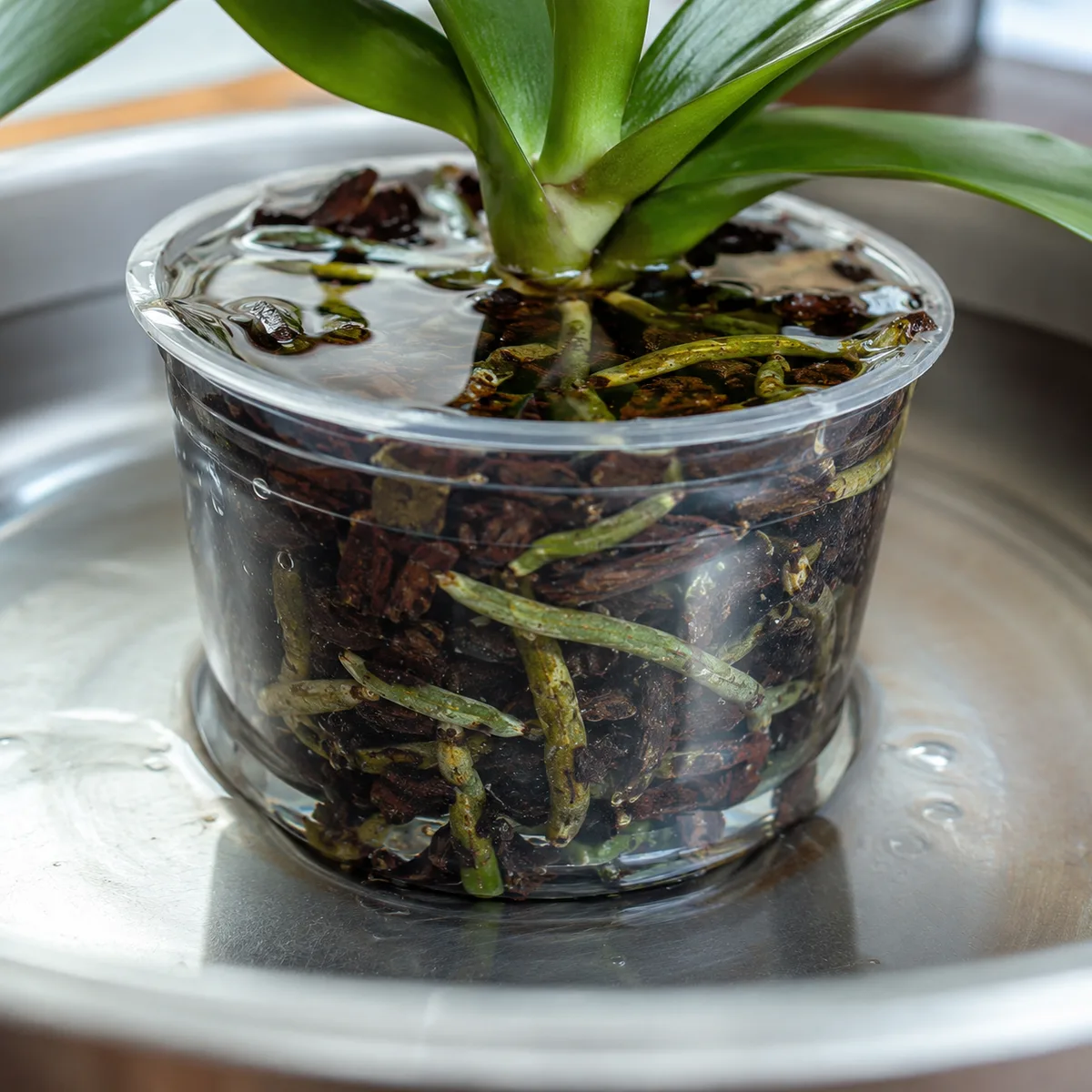
Water, and nothing else for two weeks
You will know how to decide to water from the color of the roots, and how to give water in a way that actually reaches them.
- The color of the roots: green, you do not water; silvery white, it is time. Five seconds, every three or four days.
- The fifteen minute soak, and why a small glass of water poured over the bark wets almost nothing.
- Water in the outer pot: the habit that kills the most orchids, and that you can correct tonight.
- Roots growing out of the pot: why you never push them back in, and why it is a good sign.
- The three weeks away on holiday: what you do, and what you ask nobody to do.
Light and position
You will know how to measure the light in your room with your hand, and where to put the plant without buying any device.
- The hand shadow test: how sharp the edge of the shadow is at midday tells you the real light level, without buying any device.
- Why very dark green foliage is NOT a sign of good health, and what it really says.
- The radiator under the window, the cold glass, the draught: three causes of bud drop that have nothing to do with care.
- Feed: why it comes so late in this book, and the exact answer to "which feed and how often".
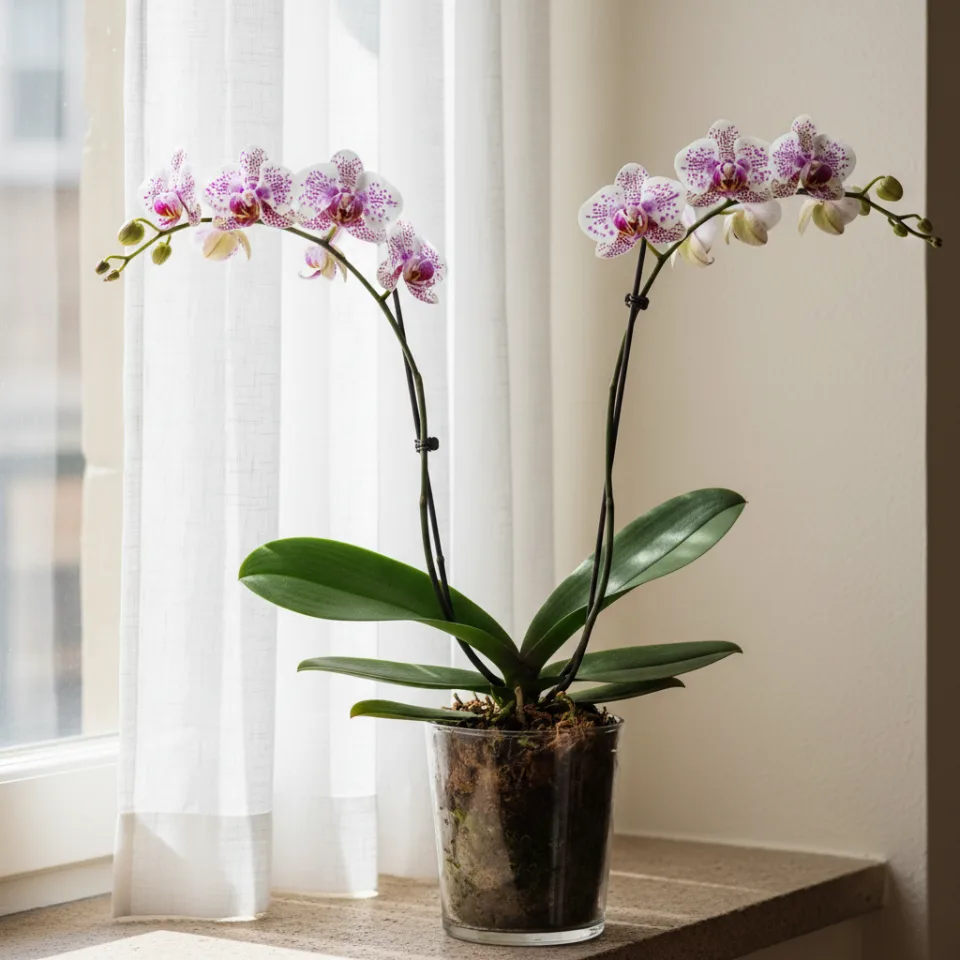
Blooming again, step by step
You will know how to give the signal that triggers a new spike, and how to give it in a heated flat.
- What actually triggers flowering, and it is not feed: a day-night temperature difference of 8 to 10 °C (14 to 18 °F), for three to four weeks, in September and October.
- Three ways to give that signal in a heated flat, from the simplest to the most deliberate.
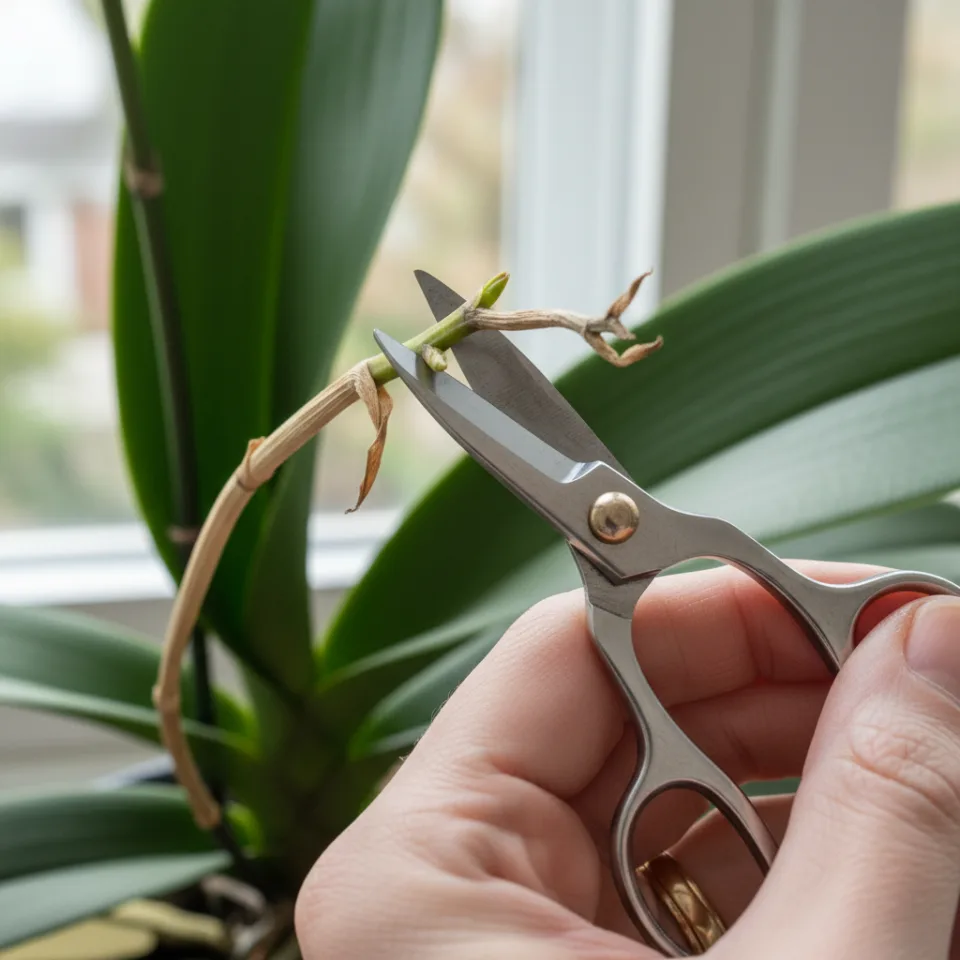
- The stem after flowering: exactly where to cut, and the two possible choices, with what each one costs you and gives you.
- A flower spike has a flattened tip, a root has a round one. The most reliable sign in the book.
- Why buds drop before they open, and the invisible cause nobody suspects: a bowl of ripe fruit in the same room.
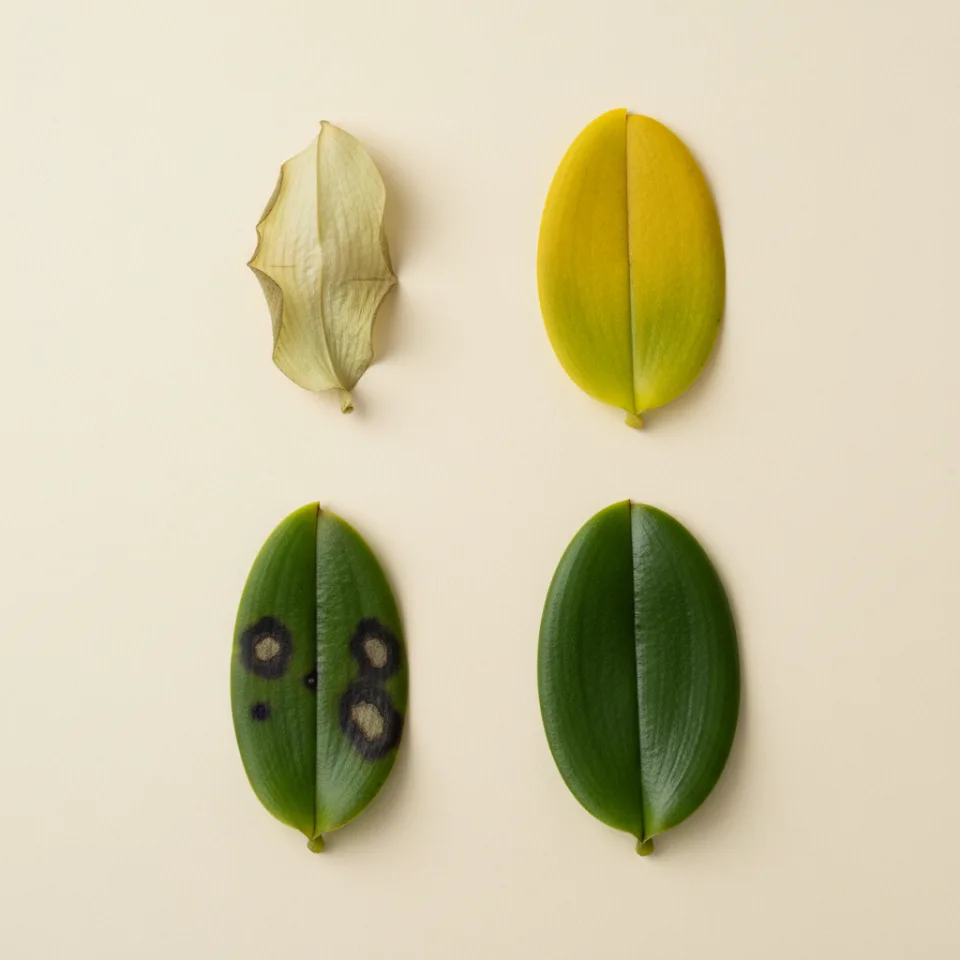
Diagnosis by symptom
You will know how to work back from what you see on the leaves to the cause, and how to save a plant whose roots are already affected.
- The lower leaves turn yellow, all the leaves are beige and limp, the leaves crease like a concertina: three symptoms, three different causes.
- Brown, soft roots: the full rescue, step by step, and the glass of water method when there is almost nothing left.
- Mealybugs: alcohol on a cotton bud, four times, seven days apart. That is the point where everyone gives up too soon.
- A small plant growing on the stem: what it is, and when to separate it without killing it.
Repotting, and the day you buy
You will know how to choose the right plant in the shop, and what to do with the first eight days at home.
- Choosing in the shop: roots before flowers, and why a plant in full bloom is already well into its flowering.
- The first eight days at home: doing nothing, but doing it properly.
- The only three good reasons to repot, and the four that are not reasons at all.
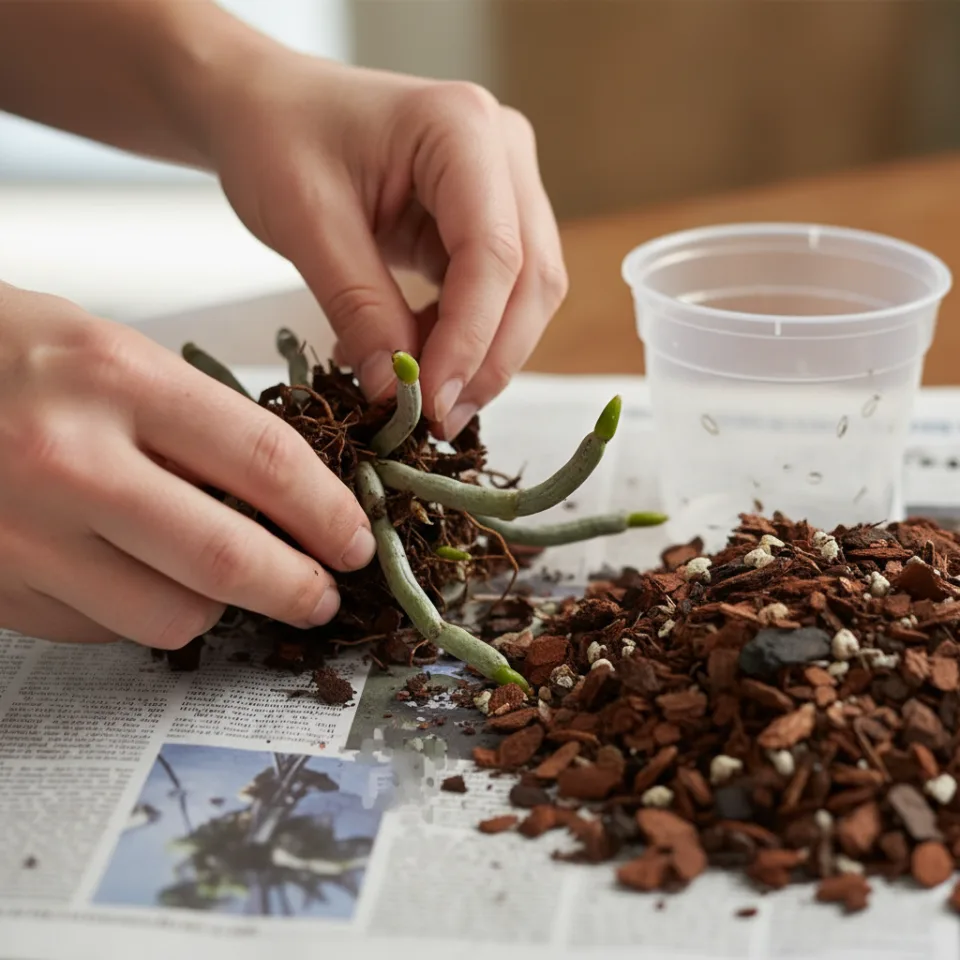
- Repotting step by step, and why you do not water for the five days that follow.
What you actually have in your hands
45 pages
"It Will Bloom Again" runs to 45 pages, with its photos and diagrams, plus the 15 page notebook if you add it. This is not a stretched out blog article: it is the whole book, in PDF, yours for life.
Everything can be checked before you even pay: you can see the full contents above, part by part, and each part matches a real chapter of the book.
What you receive today
That is everything in "It Will Bloom Again", gathered into a single file, to keep open next to your orchid while you work. Here is exactly what you receive:
- The book "It Will Bloom Again", one photo per speciesvalue $47
- The "Blooming again" section: the autumn signal, and where to cut the stemincluded
- The blooming calendar, month by month, on one page to pin upincluded
- Diagnosis by symptom, with the first thing to doincluded
- The index by symptom, written in your own wordsincluded
- Price$47
This is the price of the book, with no countdown and no timer. You keep it, with the updates.
Digital book in PDF, sent by email: nothing is posted, nothing arrives at your door.
30-day guarantee, no conditions
Read the book. Lift out the clear pot and look at the roots. Empty the outer pot. If within 30 days you feel it brings you nothing, write to us at contact@thepotmethod.com and you are refunded in full.
No form, no explanation to give, no questions. And you keep the book: I would not know how to take it back from you anyway.
In other words: either this book changes something for you, or it costs you nothing. I prefer that simple rule to a long list of conditions in small print. The only risk left is closing this page and starting again tomorrow, looking for an answer in two articles that contradict each other.
P.S. If you are skimming this page, here is the summary. For $47, you receive "It Will Bloom Again": the eleven orchids in photos, how to read the roots, the autumn signal that triggers flowering, diagnosis by symptom and the calendar for the year. If it is of no use to you, you are refunded within 30 days and you keep the book.
P.P.S. Do one thing tonight, even if you do not order. Lift the clear pot out of its outer pot. If there is water at the bottom, pour it out. Then look at the color of the roots against the light. You have just understood, for free, the heart of this book.
The Pot Method publishes practical indoor gardening guides. Nothing in this book is medical or dietary advice, and no plant in it is presented as edible.