How to find your sowing date and get sturdy seedlings, even if yours have always gone leggy.
Because the date on the packet is not yours: the spring and summer sowings are worked out from your last frost, counting backwards. Nothing to buy, no lamp, no greenhouse.
Nothing to install, no equipment to buy: a PDF book, to read next to your seedlings, and your first sowing on the right date, starting tonight.
The digital book "Sown at the Right Time", to read tonight and to apply from your next sowing window.
Keep reading if you finally want to know when to sow, where you live
Here is what you are going to understand on this page, and above all in the book that goes with it:
- Why the calendar on the packet is wrong where you live, and by exactly how many weeks.
- The only date you need to know, your last frost, and how everything else follows from it by counting backwards.
- Why your seedlings go leggy, and the three second habit that prevents it, the one almost nobody does.
- Why they collapse all at once, the stem pinched at the base, and what you must not do at that moment.
From: Élise Marchand, for The Pot Method
Place: in front of a tray of tomatoes sown six weeks too early
Dear reader,
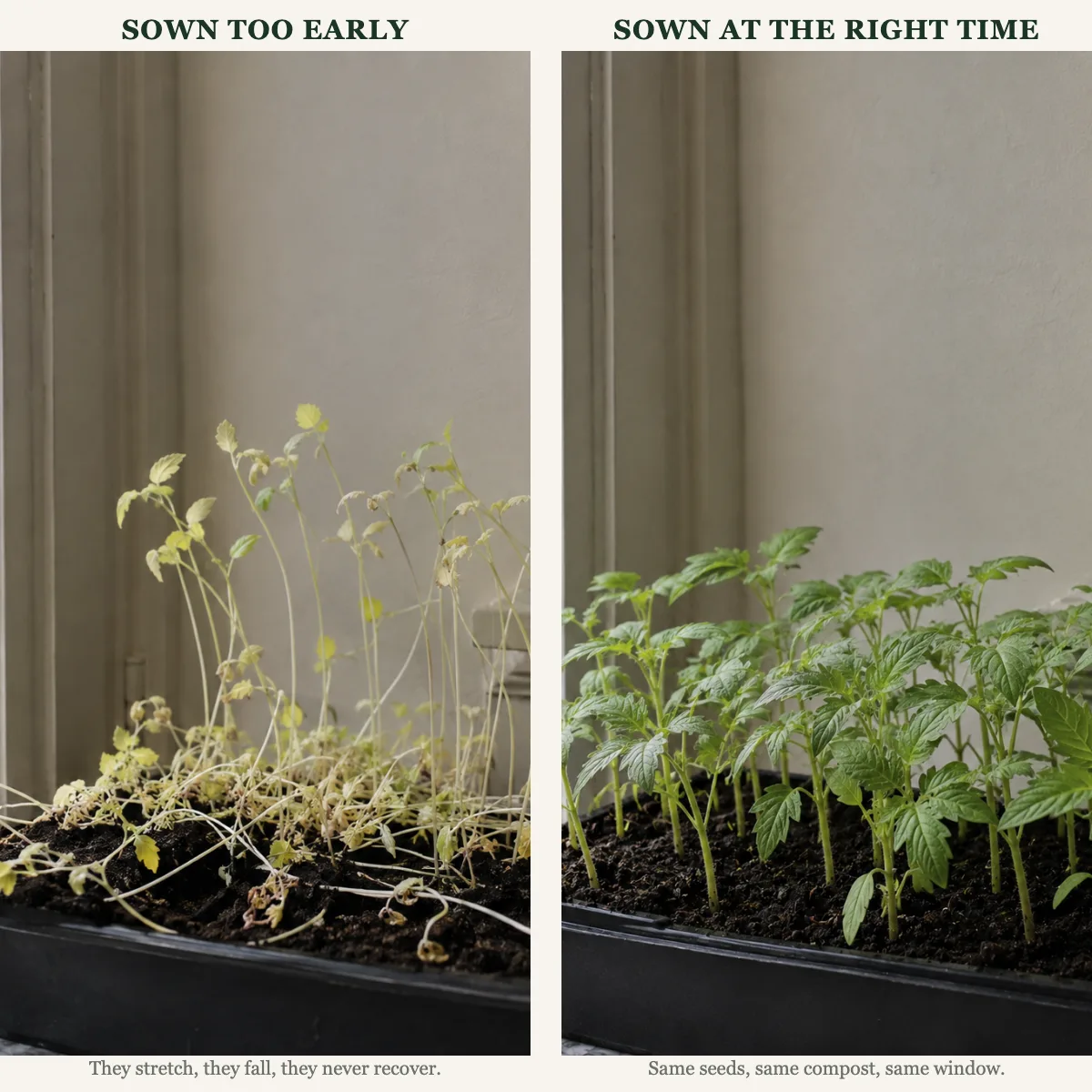
You have perhaps already sown too early, out of impatience or because the packet said so, and watched seedlings go leggy, pale and flat, before you even saw the garden.
So you start again, you buy more seed, you lose three weeks, and you end up buying ready grown plants telling yourself you cannot do it. The problem is never your set up or your patience: it is a date, and it is not written on the packet because it depends on where you live.
Open any seed packet. On the back there is a band of twelve boxes, a few of them coloured in, and the words "sow from March to May".
That band is wrong where you live. By about six weeks, one way or the other.
The same sowing date can be perfectly sensible in a mild place and far too early in a colder one, where it gives plants that are too tall, too soft, and ready six weeks before you can put them out. They will stretch on the windowsill, fall over, and you will throw them away in June wondering what you did wrong.
You did nothing wrong. You followed a date written for somebody else.
There is only one piece of information you need
It fits into three words: your last frost. It is the average date at which, where you live, the risk of frost ends.
The whole sowing calendar follows from that date, by counting weeks backwards. A tomato is sown six to eight weeks before. A pepper, ten to twelve. A bean is not sown before at all: it is sown after, straight outdoors.
It is as simple as that, and nobody writes it plainly. The book gives you your date in three minutes, with a table by region and three corrections to make for your own garden. Then it lays out everything else from there.
And the two accidents that ruin the most seedlings
There are dozens of ways to ruin a sowing. Two come up again and again.
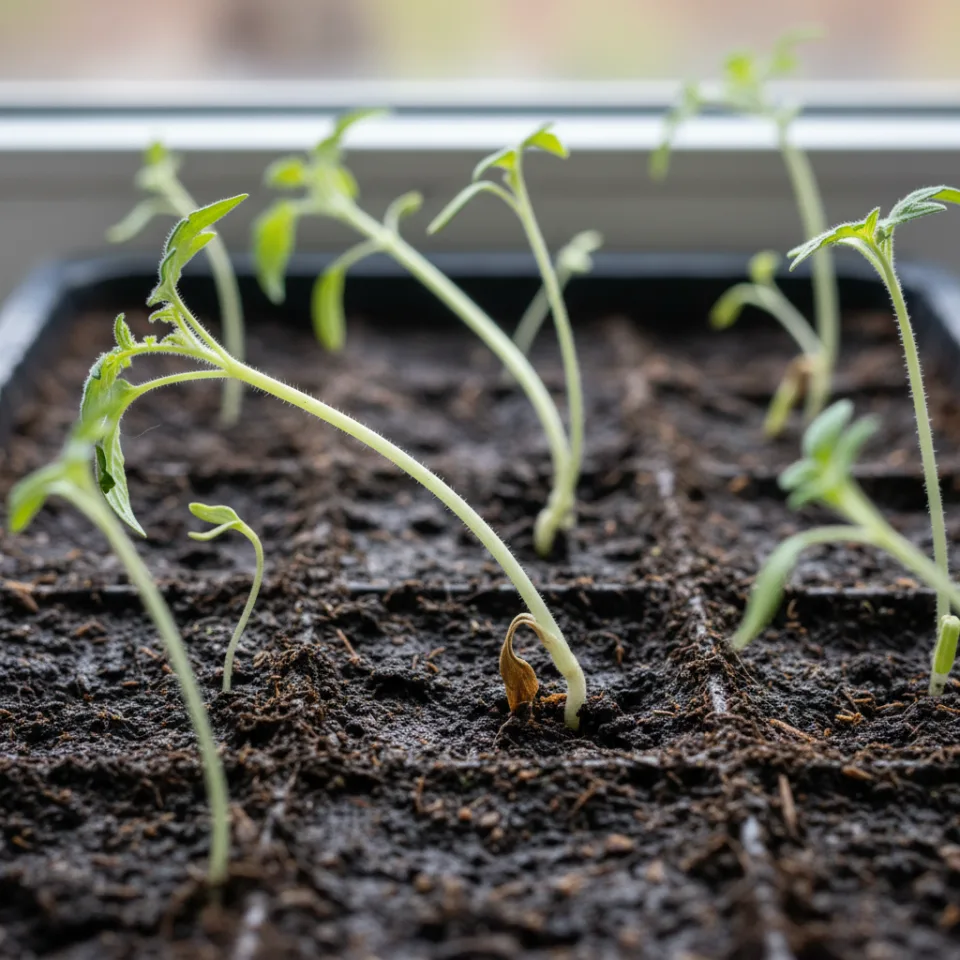
"They go leggy." The seeds come up, then make a long, thin, pale stem that falls over under its own weight. It is lack of light, almost always, made worse by a room that is too warm and tells the plant to grow fast in February light. The most effective remedy is free, and it is the one nobody wants to hear: sow later. The second fits into one sentence, and it is even less well known: as soon as they come up, drop the temperature by 3 to 5 °C (5 to 9 °F).
"They collapsed overnight." In the morning they are flat, the stem shrunken and brown right at soil level, as if pinched. Within twenty four hours half the tray goes the same way. It is a soil fungus, encouraged by too much water, too much crowding and not enough air. Gardeners call it damping off, and that is exactly why you never find the answer: you search for "my seedlings are dying", and the answer is written with a word you have never heard.
A whole section of the book deals with nothing but these two accidents, with their real causes and what prevents them. There is no equipment to buy.
For a long time you believe the problem is equipment. You buy a lamp, then a mini greenhouse, then a heat mat, and the seedlings still go leggy.
The day you work out your last frost date and count the weeks backwards for each vegetable, everything falls into place, without buying anything more. It is that counting method, and nothing else, that fills the first part of the book.
At this point, you have two options
The right sowing date is not written on the packet: it is worked out where you live.
The second option asks for one reading and one action tonight. The first costs you three weeks and a tray every time you sow too early, and the cruellest part is that you never even know you are getting it wrong.
Just imagine for a moment
- Imagine opening a seed packet and knowing straight away, without hesitating, whether it is the moment where you live or whether you need to wait three weeks.
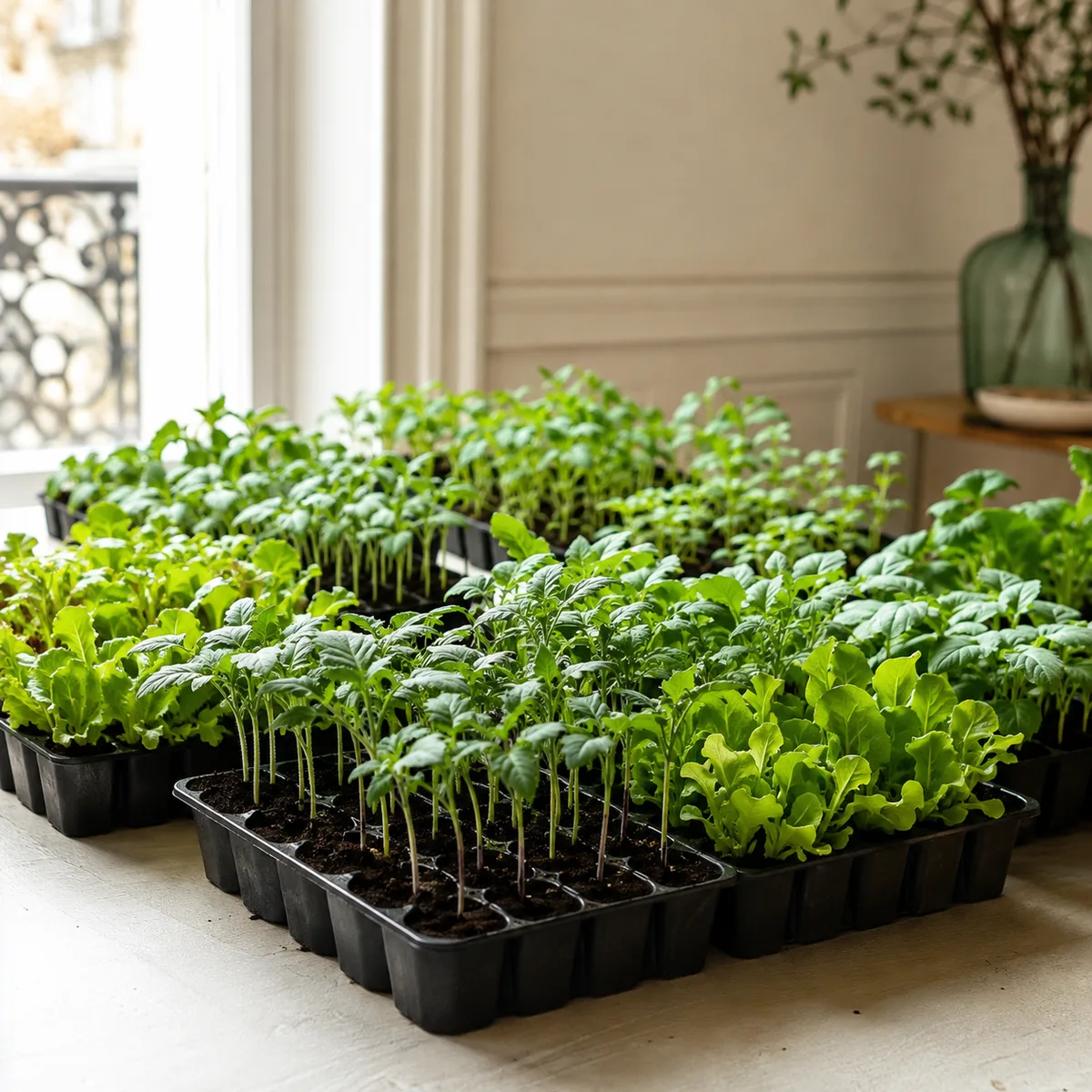
- Imagine sturdy seedlings, short and broad, instead of those pale stems that fall over.
- Imagine knowing what to sow in July and August, the two months everyone forgets and that fill the autumn.
- Imagine never work out your dates again: a table filled in once, that holds for every year to come.
What you will be able to do when you close it
- Know your last frost date, and count from it instead of following a packet.
- Know what is sown indoors and what is sown outdoors, and never start a carrot in a module again.
- Grow seedlings that are sturdy instead of leggy, with two things that cost nothing.
- Recognise damping off before it takes the whole tray, and know what to do within the hour.
- Prick out, harden off and plant out without losing the plants at the exact moment you think you have won.
- Know what to sow each month, including in July and August.
The appendices included in the book
Is this really for you?
And you?
You can close this page, and next year do exactly what you did this year. Or you can, tonight, look up your last frost date and write it down somewhere. The book is there for everything else.
Work out your sowing date, for a single variety tonight, before deciding anything at all. If you find a sowing started three weeks too early, you will know the problem was never your patience or your memory: it was that nobody had ever shown you where to look. The book is there for everything else, in order, without leaving you to choose between two opposing opinions.
"Sown at the Right Time"

A digital book in PDF format, to read on your phone in front of the seed tray, on your computer, or printed if you prefer paper. It is built around one simple idea: a date is only useful if it is yours. The spring and summer dates are written in relation to your last frost; the autumn and pre-winter sowings go by the month.
It is written for someone starting out, in the words you use. You will not read "etiolation" without a translation: you will read "they go leggy". You will not read "damping off" without an explanation: you will read "they collapse overnight, the stem pinched at the base".
What you will find inside, part by part
Start with part 1 and find your date. Five minutes, once and for all. Everything else hangs on it.
Finding your date, in three minutes
You will know the date from which you can sow where you live, corrected for your garden and not just for your region.
- How to find your own last frost date from local records, and why it is the only one that matters.
- The three corrections to make for your own garden: valley bottom, town, altitude. Two gardens three kilometers apart do not have the same date.
- Why a traditional calendar date is worth less than your local frost records and the current forecast.
- The "week minus X" rule: the table that turns your date into sowing dates, vegetable by vegetable.
- The last frost date, and why everything follows from it.
- Your date, by main region.
- Refining it for your own garden.

What is sown indoors, what is sown outdoors
You will know what deserves sowing indoors and what is spoilt by being transplanted.
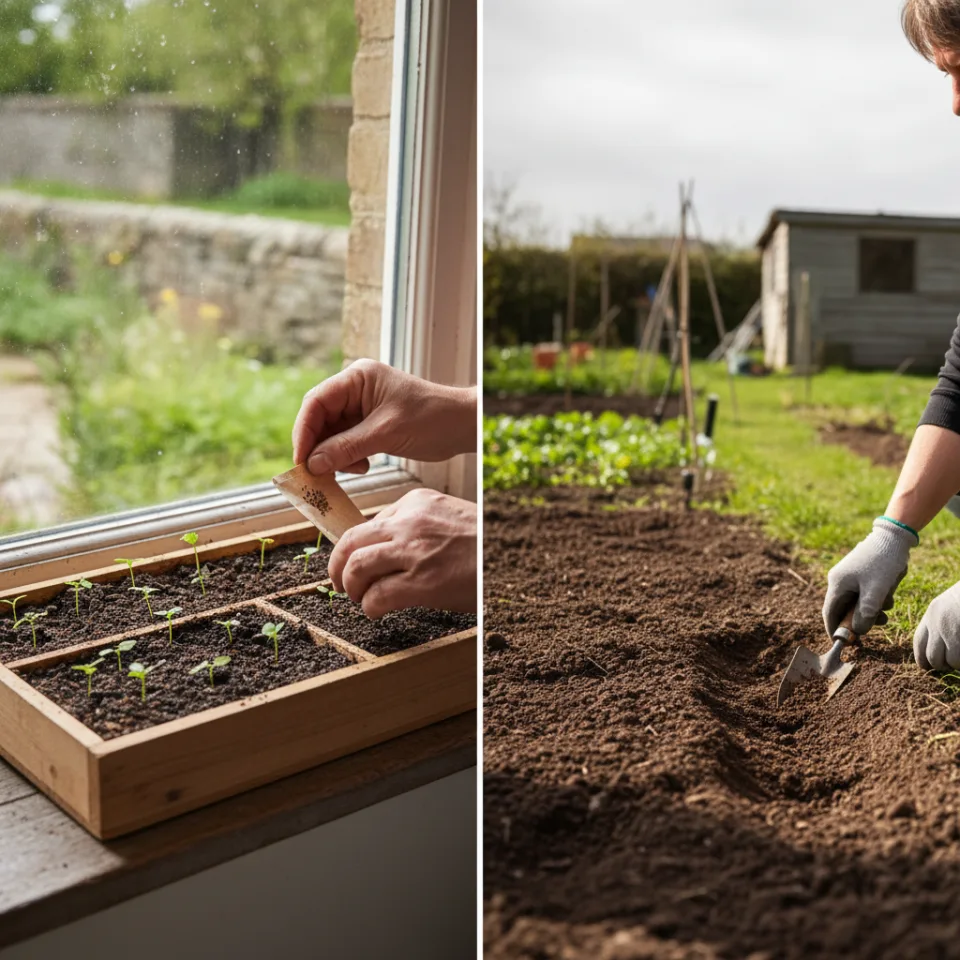
- The only reason to sow indoors, and why it does not apply to a good part of what is sown there.
- The three vegetables that fork every time if you transplant them. The carrot first of all, and it is the most common mistake.
- What you really need, and above all what you do NOT need: no greenhouse, no heat mat, no lamp.
- Sowing in seven steps, two of which almost nobody does in the right order.
- Why we sow indoors.
- The three that hate being moved.
- The list, in two columns.
The two accidents: they go leggy, they collapse
You will know how to avoid the two accidents that send you back to the start, and how to rescue seedlings that have already gone leggy.
- The three real causes of leggy seedlings, in order of frequency, and the six things that prevent them.
- The most effective thing in the book, and the least known: drop the temperature by 3 to 5 °C (5 to 9 °F) as soon as they come up.
- How to rescue a tomato seedling that has gone leggy, and why a leggy lettuce cannot be rescued.
- Damping off: water from below, take the lid off as soon as they come up, sow thinly, and never water in the evening.
- "Nothing is coming up": four causes, and the ten seed test that saves a whole season.
- "They go leggy": what is really happening.
- What stops seedlings going leggy.
- "They collapse overnight".
The calendar, month by month
You will know what to sow this month, and above all what not to sow so you do not lose your season.
- Twelve months, three columns: what is sown indoors, what is sown outdoors, and what you do not do.
- January and December, the two months when you lose your season by trying to start it.
- May, the month that decides, and why one fine week does not move a frost date.
- July and August, the two forgotten months, which fill the whole of autumn and winter.
- The soil test in March: a handful squeezed in your hand, and you know whether it is too early.
- February.
- April.
- June.
Prick out, harden off, plant out
You will know how to put your plants out without losing them, with the seven to ten day stage almost everyone skips.
- How to prick out, and the rule that saves the seedlings: you lift by a LEAF, never by the stem.
- Hardening off over seven to ten days, day by day. It is the stage everyone skips, and the one that costs the most.
- Planting day: in cloudy weather, the ten day forecast, and the fleece that buys you a little protection.
- The real spacing between two plants, which is always too tight. Ten tomato plants with room give you more than twenty crammed together.
- Pricking out: when, and why.
- Hardening off: the stage everyone skips.
- Planting out: the day, and the weather.

What you actually have in your hands
33 pages
"Sown at the Right Time" runs to 33 pages, with its photos and diagrams, plus the 15 page notebook if you add it. This is not a stretched out blog article: it is the whole book, in PDF, yours for life.
Everything can be checked before you even pay: you can see the full contents above, part by part, and each part matches a real chapter of the book.
What you receive today
That is everything in "Sown at the Right Time", gathered into a single file, to keep open next to your seedlings while you work. Here is exactly what you receive:
- The book "Sown at the Right Time", one photo per vegetablevalue $47
- The "Two accidents" section: they go leggy, they collapse, and how to prevent itincluded
- The sowing calendar, month by month, on one page to pin upincluded
- The "Prick out, harden off, plant out" section, day by dayincluded
- The index by problem, written in your own wordsincluded
- Price$47
This is the price of the book, with no countdown and no timer. You keep it, with the updates.
Digital book in PDF, sent by email: nothing is posted, nothing arrives at your door.
30-day guarantee, no conditions
Read the book. Write down your last frost date. Count your weeks backwards. If within 30 days you feel it brings you nothing, write to us at contact@thepotmethod.com and you are refunded in full.
No form, no explanation to give, no questions. And you keep the book: I would not know how to take it back from you anyway.
In other words: either this book changes something for you, or it costs you nothing. I prefer that simple rule to a long list of conditions in small print. The only risk left is closing this page and starting again tomorrow, looking for an answer in two articles that contradict each other.
P.S. If you are skimming this page, here is the summary. For $47, you receive "Sown at the Right Time": your frost date in three minutes, the twelve vegetables in photos, the two accidents that ruin the most seedlings, the month by month calendar, and the three stages where the most plants are lost. If it is of no use to you, you are refunded within 30 days and you keep the book.
P.P.S. Do one thing tonight, even if you do not order. Look up the last frost date for your area and write it on a piece of paper you will keep. It is the most useful piece of information in the whole book, and you will have got it for free.
The Pot Method publishes practical gardening guides. This book is about sowing and raising young plants, and nothing in it is medical or nutritional advice.